Description
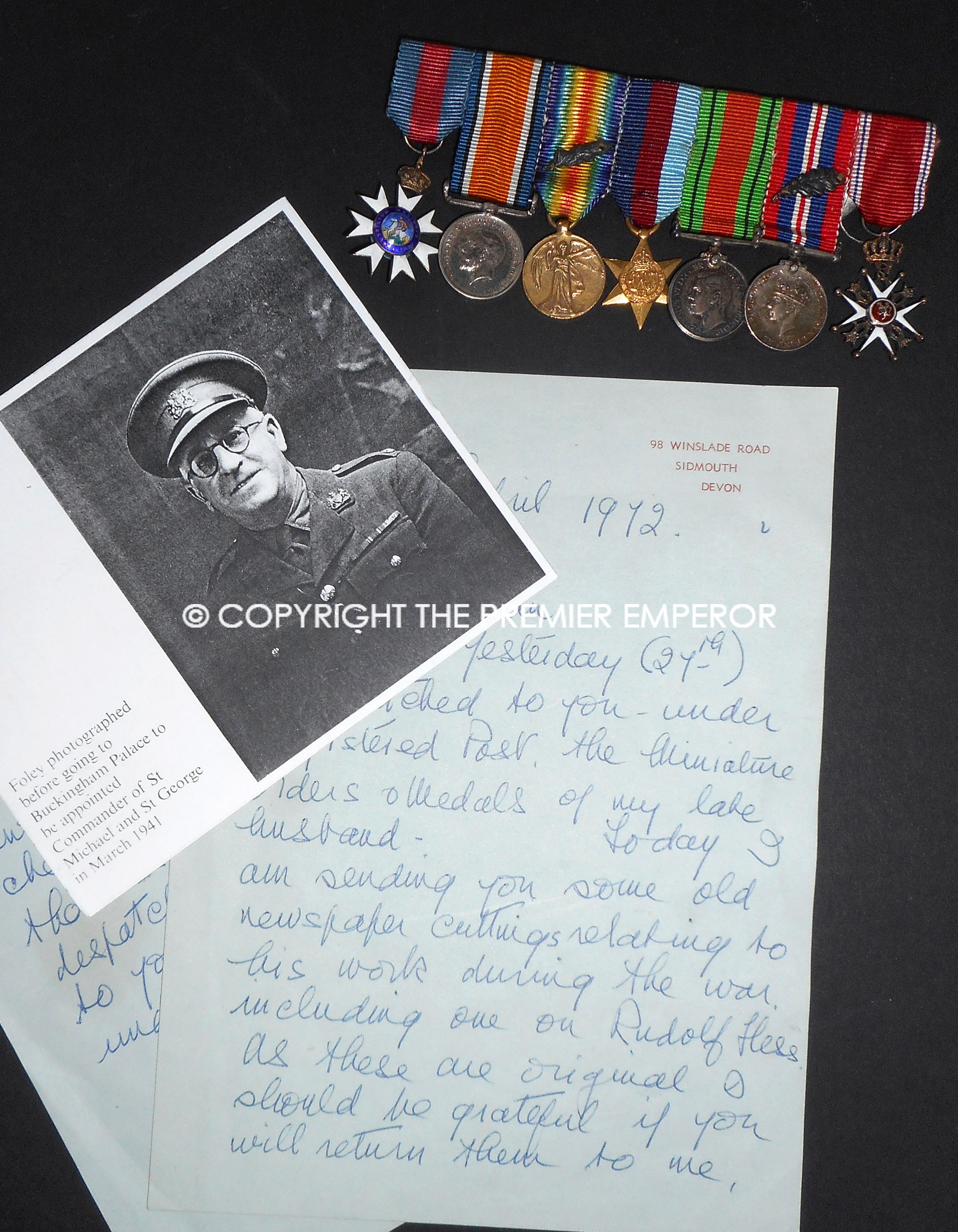
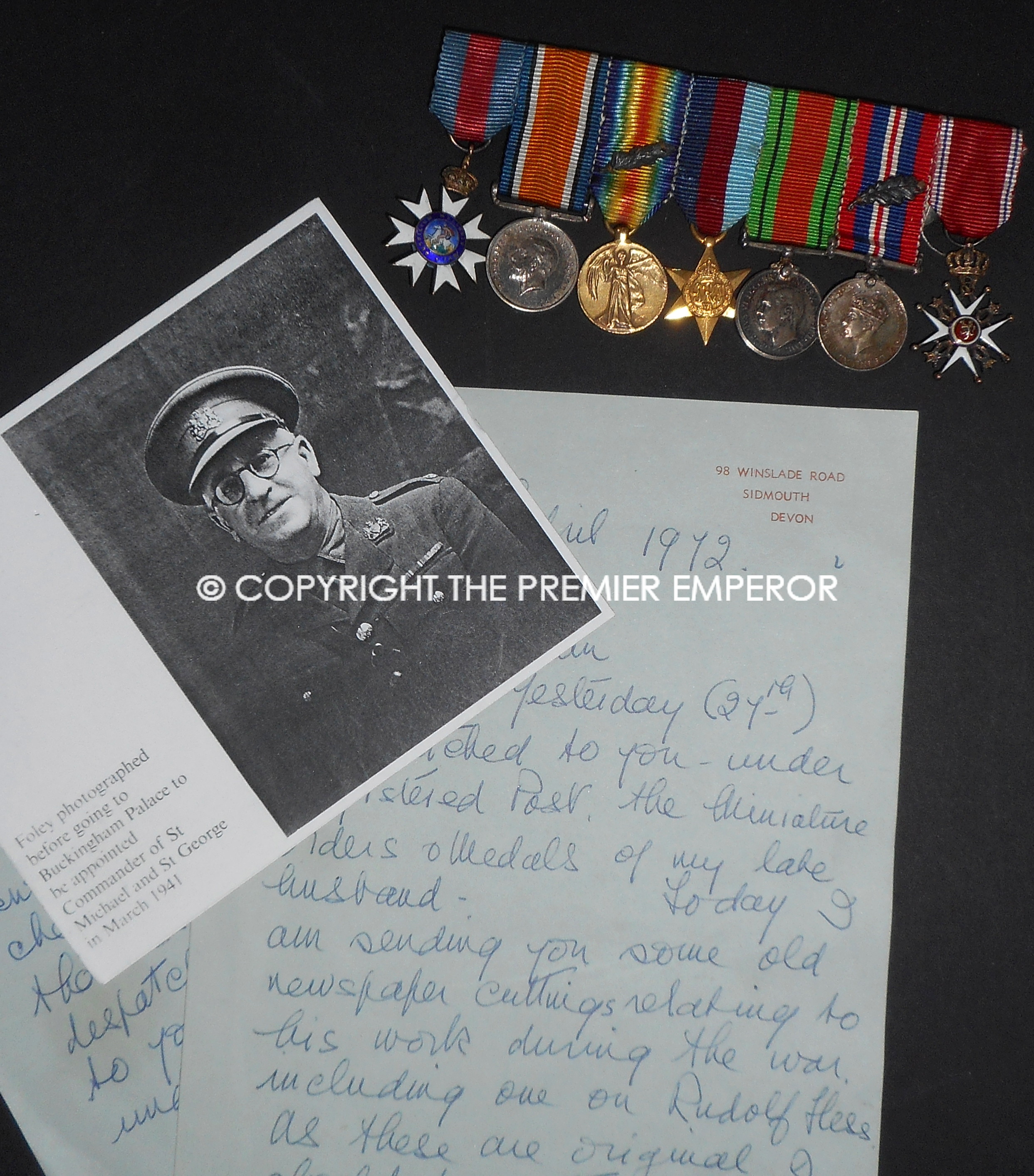
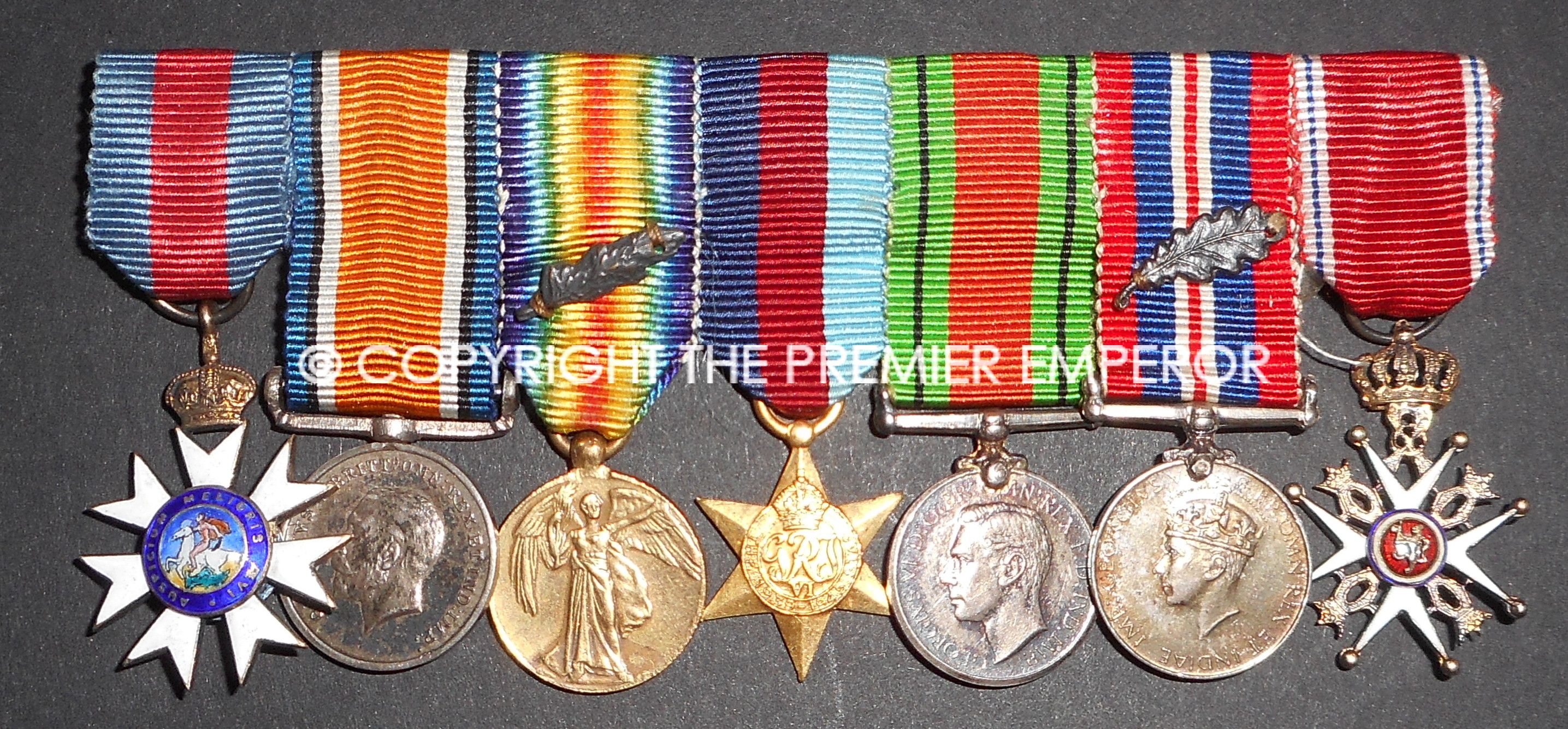
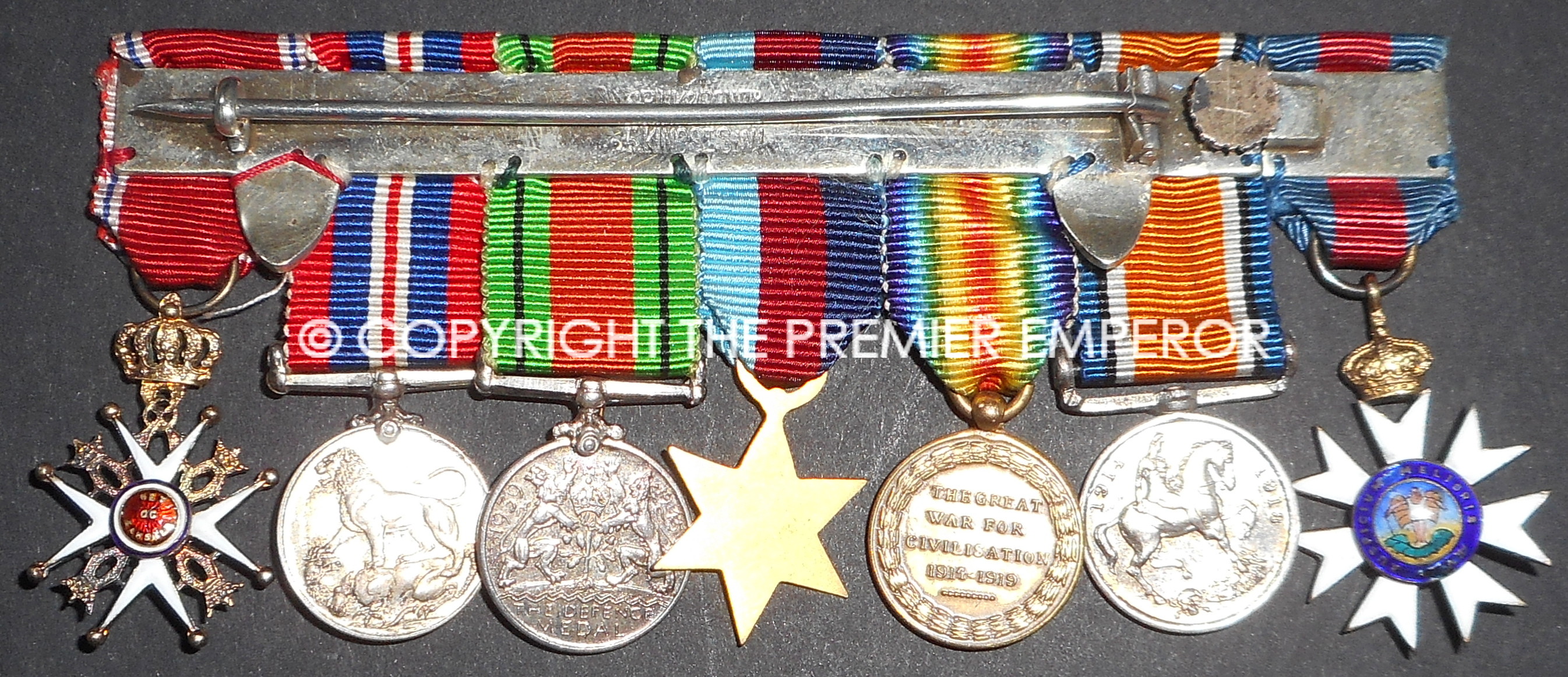
British. 100% Authentic Miniature group of medals belonging to Colonel Frank Foley MI6. with Rudolph Hess related items.
We are very privileged to own and be able to offer for sale this superb group of Miniatures and related ephemera to one of the UK’s greatest War Hero’s.
The miniature medal group consists of :-
Commander of the Order of St.Michael & St.George,(Citation reads: for valuable services rendered to the State),British war medal 1914/1918,Victory medal with Mention in Despatchs 1914/1919, 1939/1945 Star (awarded for service in an operational area),Defence medal 1939/45, War medal 1939/45 with Mention in despatches(For actions during the Norwegian campaign) and the Knights Cross of St.Olaf.1st class(Awarded to foley by King Haakon of Norway.The citation reads: Foley spared no effort to assist the Norwegian forces in their fight against the Germans and was repeatedly very dangerously exposed to enemy fire). The mounted miniatures come with original letters from Foley’s wife selling them to the Forman Archive in 1972 and also items from Foleys meeting with Rudolph Hess including an original X-Ray of Hess’s leg after he parachuted into Scotland during the war together with original letters from Hess’s wife and also photocopies of paperwork on Hess during his time in captivity in Scotland and Spandau prison, all items were the property of Foley and come with this superb historically important group of miniatures and ephemera.,
BRIEF HISTORY ON THIS INCREDIBLE MAN.
Foley’s Early life
He was the third son of Isabella and Andrew Wood Foley, a Tiverton-born railway worker, whose family may have originated from Roscommon in Ireland in the early 1800s. After attending local schools in Somerset, Foley won a scholarship to Stonyhurst College,Lancashire where he was educated by the Jesuits. He then went to a Catholic seminary in France to train as a priest but transferred to the Universite de France in Poitiers to study Classics. While there he reconsidered his vocation for the priesthood and decided instead to pursue an academic career. He travelled extensively in Europe, becoming fluent in both French and German.
Foley graduated from the Royal Military College,Sandhurst, and was commissioned as a second lieutenant into the Hertfordshire Regiment on 25 January 1917.He was appointed temporary Captain on 20 September 1917, while commanding an infantry company of the 1st Battalion the Hertfordshire Regiment and was later with the 2nd/6th Battalion North Staffordshire Regiment, during which time he was mentioned in despatches.
Foley and the Secret Service MI6.
The story of his escape from Germany and his language skills had been noted by someone at the War Office. He was encouraged to apply for the Intelligence Corps. On 25 July 1918 Foley was promoted Lieutenant. In July 1918 he became part of a small unit which was responsible for recruiting and running networks of secret agents in France, Belgium and the Netherlands. After a few weeks he was sent to France, where after the Armistice he served for a short time in the Inter-Allied Military Commission of Control in Cologne. On 19 April 1920 he relinquished the temporary rank of captain, and in December 1921 retired from the Army with the rank of Captain
After the running down of the Commission, he was subsequently offered the post of passport control officer in Berlin which was a cover for his main duties as head of the British Secret Intelligence Service MI6 station. During the 1920s and 30s, Foley was successful in recruiting agents and acquiring key details of German military research and development.
Foley is primarily remembered as a “British Schindler”. In his role as passport control officer he helped thousands of Jews escape from Nazi Germany. At the 1961 trial of former ranking Nazi Adolf Eichmann, he was described as a “Scarlet Pimpernel” for the way he risked his own life to save Jews threatened with death by the Nazis. Despite having no diplomatic immunity and being liable to arrest at any time, Foley would bend the rules when stamping passports and issuing visas, to allow Jews to escape “legally” to Britain or Palestine, which was then controlled by the British. Sometimes he went further, going into internment camps to get Jews out, hiding them in his home, and helping them get forged passports. One Jewish aid worker estimated that he saved “tens of thousands” of people from the Holocaust.
In 1939 and 1940 he was passport control officer in Norway until the Germans invaded at which time he was attached to C-in-C Norwegian Forces in the Field, for which services he received the Norwegian Knight’s Cross of the Order of St.Olaf.
On 1 January 1941 he was awarded Companion of the Order of St.Michaerl & St.George (CMG) as a Captain in respect of services to the Foreign Office. In 1941, he was given the task of questioning Hitler’s Deputy Rudolph Hess, after Hess’s flight to Scotland. After Hess was hospitalised in 1942, Foley helped co-ordinate MI5 and MI6 in running a network of double agents called the Double Cross System.
He returned to Berlin very soon after the war under the cover of Assistant Inspector General of the Public Safety Branch of the Control Commission in Germany, where he was involved in hunting for ex-SS war criminals.
In 1949 Foley retired to Stourbridge, Worcestershire, and died there in 1958; he is buried in Stourbridge Cemetery. On 27 April 1961 the Daily Mail carried the story, written by his widow, of his activities to save as many Jews as he possibly could with visas to the United Kingdom. Where no excuse could be found for a visa to Britain he contacted friends working within the embassies of other nations for their assistance in granting visas to their countries. His widow Katharine Eva Foley died on 17 April 1979 at her home in Sidmouth, Devon.
Posthumous recognition
Foley was accorded the status of a Righteous Among the Nations by Israel’s Yad Vashem as a direct result of testimony from “living witnesses” found by Michael Smith while researching his biography of Foley. Lord Janner, chairman of the Holocaust Educational Trust, was instrumental in persuading Yad Vashem to look at Smith’s evidence. Some members of the Yad Vashem committee that determines whether someone should be named as a “righteous gentile” were initially sceptical that a MI6 officer would not have diplomatic immunity but the then Foreign Office historian Gill Bennett produced previously classified documents that demonstrated this to be the case. The cover of Smith’s book features the photograph from Foley’s first diplomatic passport with the date it was issued clearly shown as 11 August 1939.
In 2004 a remembrance plaque was dedicated to him at the entrance to Stourbridge’s Mary Stevens Park.The following year volunteers from Highbridge, Foley’s birthplace, raised money to erect their own tribute.
A statue was commissioned from sculptor Jonathan Sells and unveiled on the anniversary of VE Day, which is also the anniversary of his death. The ‘Frank Foley Parkway’ between Highbridge and Burnham on Sea opened on 7 July 2009.
In 2007, a film about Foley’s life was in the planning stages, but the producers were then taking legal action against MI6 to release still-classified documents related to his work.
On 24 November 2004 (the 120th anniversary of his birth) descendants of Foley, relatives of those he saved, representatives of Jewish organisations, British MPs and other well-wishers gathered at the British Embassy in Berlin for the unveiling of a plaque in honour of Foley. At the ceremony Foreign Secretary Jack Straw praised Foley’s heroism:
Frank Foley risked his life to save the lives of thousands of German Jews. Without the protection of diplomatic immunity he visited internment camps and sheltered Jewish refugees in his house. Frank Foley was a true British hero. It is right that we should honour him at the British Embassy in Berlin, not far from where he once worked.
On 31 May 2009, a garden was dedicated in his memory at London’s Sternberg Centre, where a plaque was unveiled by Cherie Booth.
In 2010, Foley was named a British Hero of the Holocaust by the British Government.
In 2012 the Foreign Secretary, William Hague, unveiled a plaque to him at the Hoop Lane Jewish Cemetery in Golders Green, London, an initiative led by the Spanish and Portuguese Jews’ Congregation and West Londion Synagogue.
A National Express West Midlands bus is dedicated to him.
**IMPORTANT
Post & Packaging Worldwide is FREE